car · Honda · Introduced 1991
Honda Beat: Big sports-car ideas, tiny package
Two seats, an open roof and the engine behind you. The Beat squeezes a surprising amount of character into 3.3 metres.
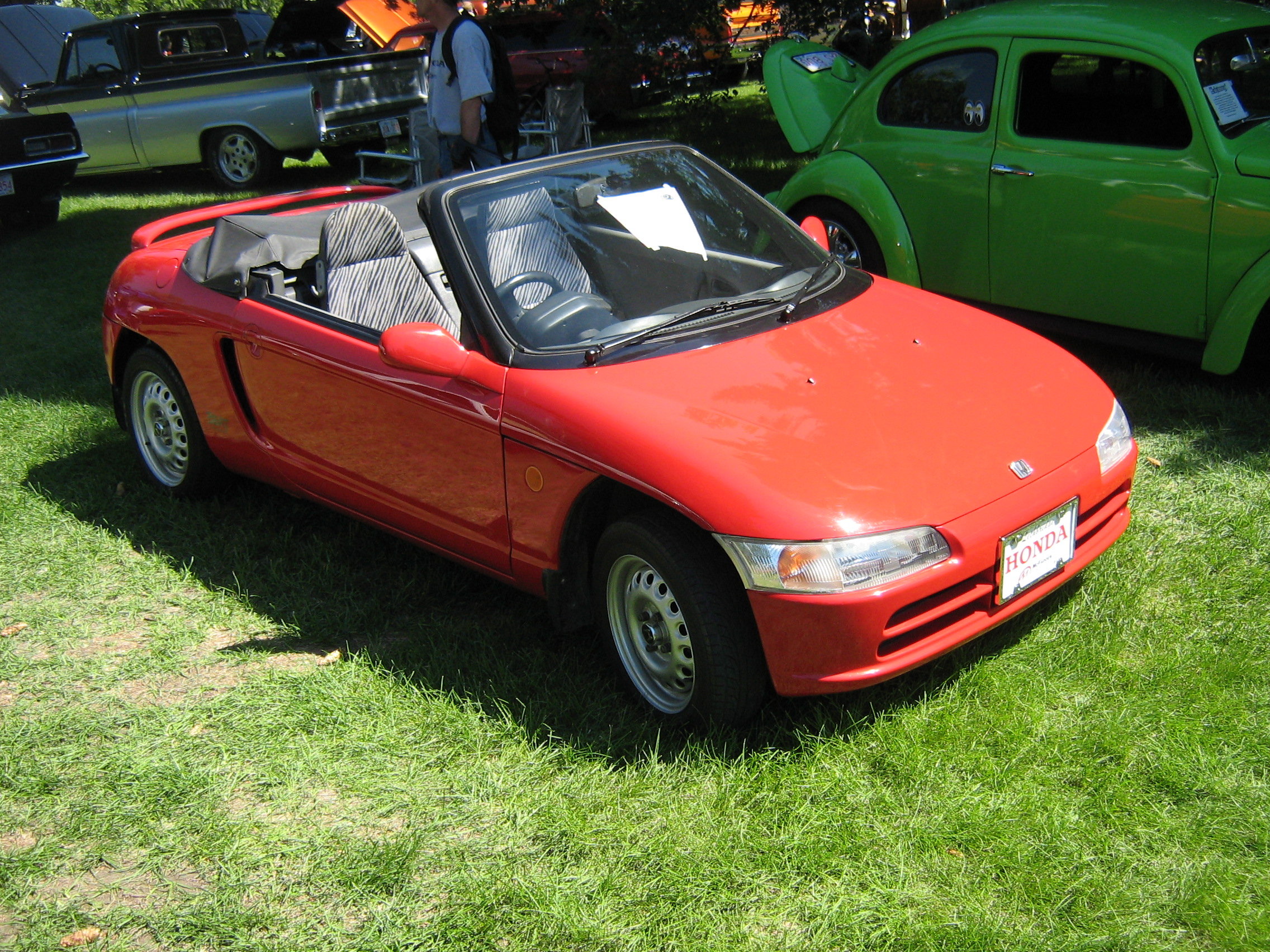
Honda_Beat.jpg · dave_7 · CC BY-SA 2.0
JPEG recompressed; pixel dimensions unchanged. Scaled to fit the page. Photo remains under its stated license.
At a glance
| Maker | Honda |
|---|---|
| Type | Car |
| Introduced | 1991 |
| Engine | 656 cc three-cylinder, mid-mounted |
| Length | 3,295 mm |
Sports-car choices in a tiny footprint
Honda introduced the Beat in May 1991. Its engine sits behind the occupants and drives the rear wheels, while the open body has only two seats. Honda’s retrospective lists a length of 3,295 mm and a 656 cc three-cylinder engine. Those facts explain the interesting challenge: organising a complete sports-car layout inside a very small body rather than merely fitting a sporty badge to a compact car.
Responsiveness was a design theme
The Beat used natural aspiration rather than a turbocharger. Honda highlights a separate throttle for each cylinder, a short 40 mm gearshift stroke and different front and rear tyre sizes. These details are more useful than a vague claim that the car is fun: they identify specific choices you can inspect in the manufacturer’s account. They do not substitute for a road test of a particular, decades-old example.
Compare the idea with the Cappuccino
The Cappuccino is an instructive comparison: Suzuki chose a front-mounted turbo engine, rear-wheel drive and a removable roof with several arrangements. Honda’s mid-engine, naturally aspirated approach therefore represents a different packaging decision. Sketch the positions of the engine, occupants and driven wheels; that comparison reveals more than treating both cars as interchangeable small roadsters.
Read retrospective material in its period
Honda’s linked article was written in 2013, even though it remains accessible today. Its comments about popularity are not a current market survey. Use the archived specifications to understand the original model, and check a car’s year, modifications and condition separately. The photograph here is a historical model reference, not evidence of a vehicle available to buy.
Model history and photograph may show different years or specifications. These are model-reference photographs, not vehicles offered for sale. No photographer or manufacturer endorsement is implied.
Official sources
Original English guide · sources checked 2026-10-06. This is a source-check date, not a new publication or live availability claim.
- Honda: Beat retrospective and original specifications · checked 2026-10-06
- Suzuki: Cappuccino design comparison · checked 2026-10-06