Car · Nissan
Nissan Sakura: A Nissan kei car
The Sakura is Nissan's first battery-electric kei car, introduced in May 2022 and named after the cherry blossom. It completes a logic the kei class was always pointing at: the trips are short, the speeds are low, the car sits at home overnight — so a small battery is not a compromise but a fit.

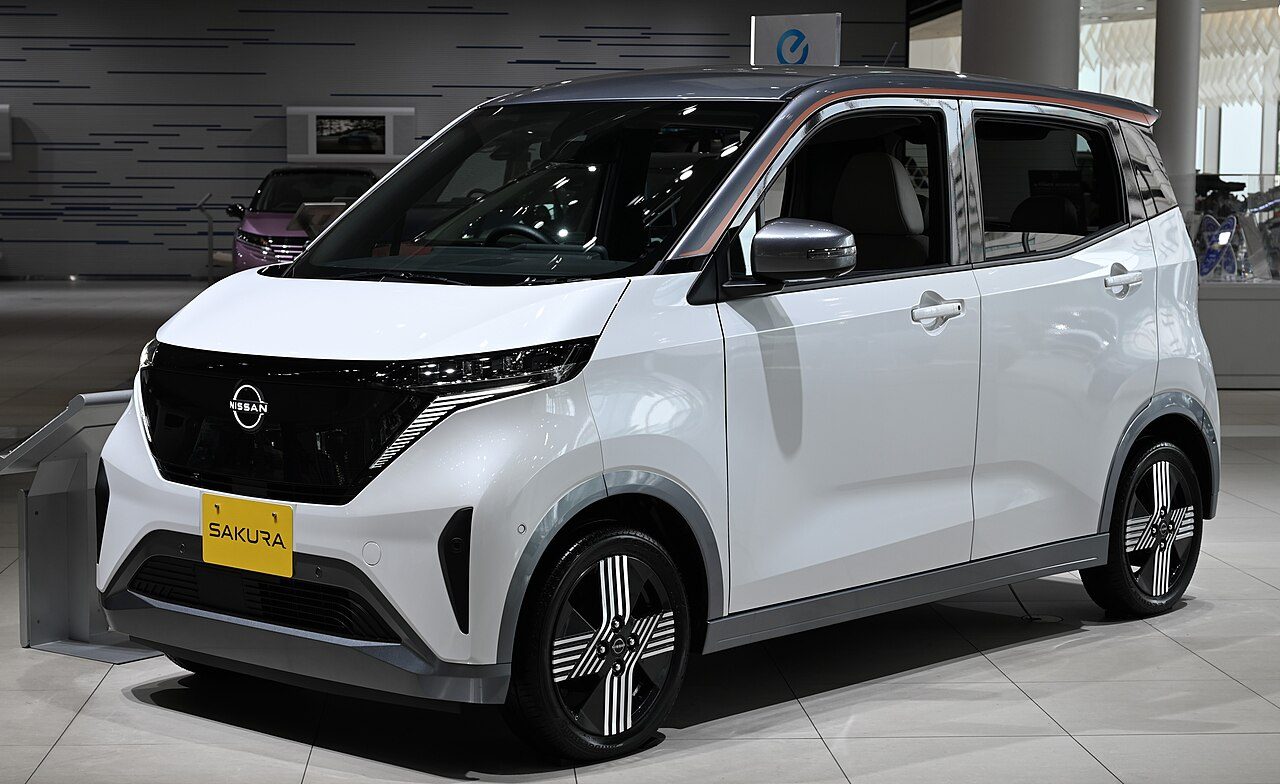
2022 Nissan Sakura G ZAA-B6AW (20220819).jpg · オーバードライブ83 · CC BY-SA 4.0
Unmodified image file; scaled to fit the page. Photo remains under its stated license.
At a glance
| Maker | Nissan |
|---|---|
| Type | Car |
| Power | Electric motor |
| Length | 3,395 mm |
| Width | 1,475 mm |
| Height | 1,655 mm |
| Wheelbase | 2,495 mm |
Overview
The Nissan Sakura is a battery electric kei car marketed by Nissan and produced by NMKV. Named after the national flower of Japan, it was introduced on 20 May 2022 as the first battery electric kei car from Nissan. It is developed and manufactured alongside the Mitsubishi eK X EV (pronounced "EK Cross"), which shares its body structure with the petrol-powered eK X (also sold as the Nissan Dayz). The only external shared parts are the windshield, door handles, and wing mirrors. Its design was previewed by the IMk concept which was showcased in 2019. Mitsubishi's internal model code is B6AW, while Nissan refers to it as the KE0.
Concept model
The production model of the Sakura is based on the Nissan IMk concept, an electric kei car concept unveiled during the 2019 Tokyo Motor Show. The name IMk is a portmanteau for Intelligent Mobility K-car .
According to Nissan, the exterior design was inspired by mizuhiki patterns, while the front grille and rear combination lamps feature a lattice pattern that mimics wood, resulting in a dynamic design that would later be seen in the Ariya and the E13 Note.
Production model
The Mass production was announced in 2021, and assembled in Mitsubishi Mizushima Plant. For Mizushima plant, it is the second EV car were produced after the i-MiEV which was discontinued in the same year. The Sakura nameplate was revealed in May 2022 along with OEM rebadged version Mitsubishi eK X EV.
The exterior features entirely new body panels except for the front windshield, door mirrors, and door handles. The front face eliminates the prominent grille and adopts a shield design which was used from the Ariya. The taillights are a long bar type, and the NISSAN lettering as the Ariya and the third-generation Note is placed below the centre. The colour options were available in solid colours and two-tone colours. Eleven solid colors, four two-tone colours, were available.
Specifications
The Sakura is powered by a single electric motor with a maximum output of 47 kW (63 hp; 64 PS) and a maximum torque output of 195 N⋅m (20 kg⋅m; 144 lb⋅ft) and can reach a top speed of 130 km/h (81 mph). The battery storage consists of a 20 kWh lithium-ion unit with an estimated WLTC range of 180 km (110 mi). Grade levels available are S, X and G, with S being intended for commercial users, X being more comfortably equipped for private buyers, and the G being the most luxurious variant, with a variety of driving aids and adaptive LED headlights amongst other standard equipment. The S omits the fabric covered dashboard amongst other creature comforts, and can be recognized by its steel wheels with full wheel covers. The Sakura has been sold in Japan since May 2022.
Living with it
Developed with Mitsubishi (whose eK X EV is its twin), the Sakura brought electric running to the price and tax class where running costs matter most.
Model history and photograph may show different years or specifications. These are model-reference photographs, not vehicles offered for sale. No photographer or manufacturer endorsement is implied.
Sources and image credit
Structured record: Wikidata Q112078178 · checked 2026-11-03. The At a glance table is drawn from that record; fields the record does not contain are omitted.
Text adapted from the English Wikipedia article “Nissan Sakura” (en.wikipedia.org), CC BY-SA 4.0 · checked 2026-11-03.