Car · Subaru
Subaru Sambar: A Subaru kei microvan
The Sambar is a working institution: Subaru's cab-over kei truck and microvan, introduced in 1961 as Japan's second keitora and still in production in its eighth generation. Farmers, foresters and tradespeople across the mountains of Japan have loaded their lives onto its flat bed.

Subaru Sambar Truck TC AWD (Stylish Pack) S510J 0505.JPG · DY5W-sport · CC BY-SA 4.0
Unmodified image file; scaled to fit the page. Photo remains under its stated license.
At a glance
| Maker | Subaru |
|---|---|
| Type | Car |
| Length | 2,990 mm |
First generation (1961–1966)
Introduced at the 1960 Tokyo Motor Show in passenger and commercial versions, the Sambar featured 4-wheel independent suspension, a rear engine, rear drive layout — and a one-box body configuration based on the Subaru 360 platform and inspired by the 1957 Fiat 600 Multipla. The chassis uses a ladder frame construction, with a rear torsion bar trailing arm suspension. The reverse gearshift position was a left-pattern selection, instead of a right-pattern selection, and the EK series engine could be accessed via a hatch inside the vehicle. Maximum power from the two-stroke twin was 18 PS (13.2 kW; 17.8 bhp). As with the Subaru 360, front doors were rear-hinged. Rear doors were front-hinged, with a rear cargo hatch. Provisional camping bunk beds were available.
Commercial variants of the Sambar were marketed for delivery use, nicknamed the "kuchibiru ([lower] lip)" Sambar, inspired by a competitor, the 1959–1961 Kurogane Baby. Other competitors included the front-engined Suzulight Carry which placed the engine in front of the driver, but also adopted the cabover approach in 1966, and the 1964 Daihatsu Hijet cabover.
The Subaru cabover configuration followed the 1950 Volkswagen Type 2, and was introduced the same year as the 1961 Ford Econoline, and the 1961 Chevrolet Greenbrier.
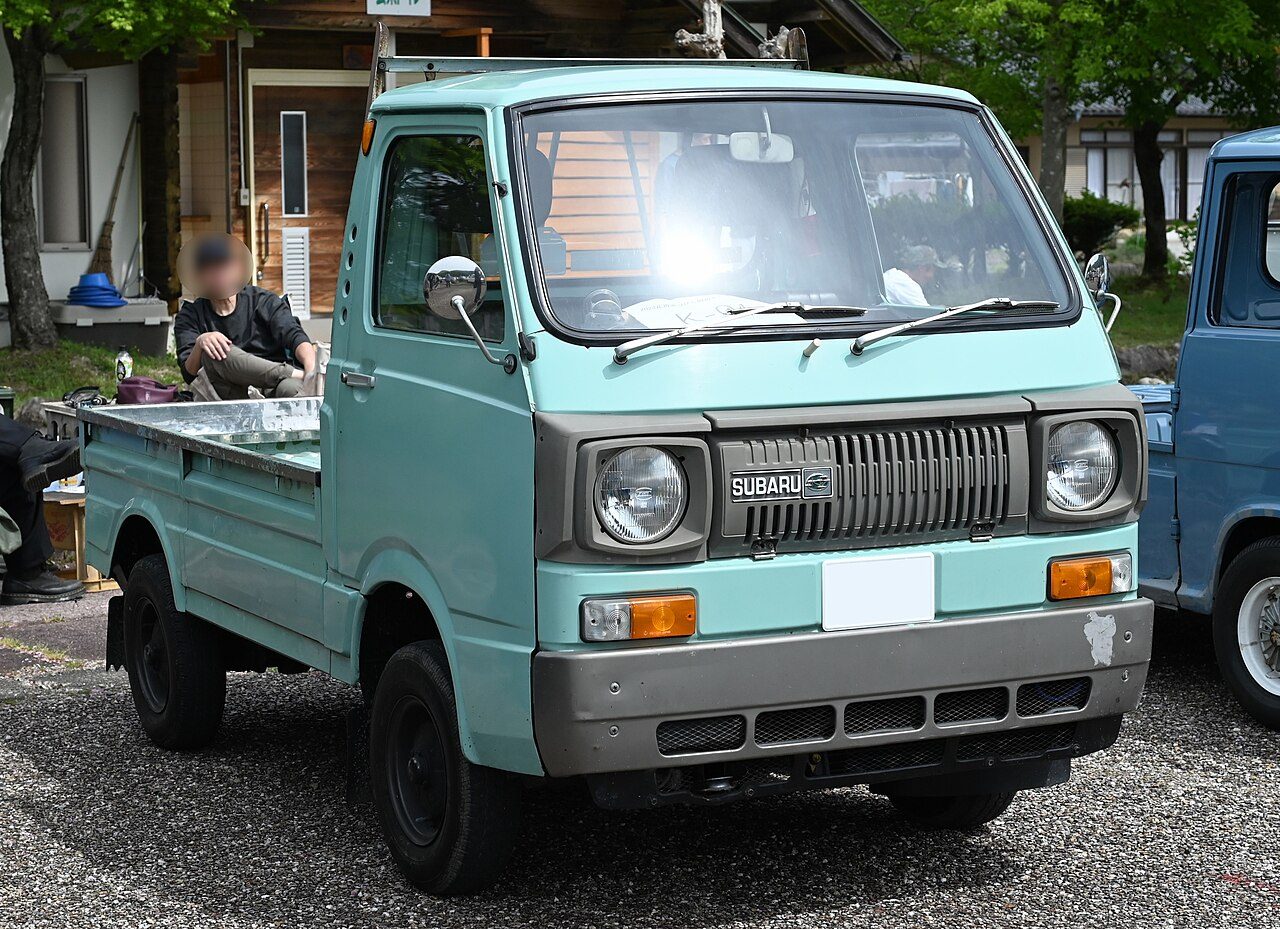
Second generation (1966–1973)
The redesigned Sambar debuted in January 1966 with revised styling and a truck variant. The second generation is nicknamed the "baban" Sambar.
The Sambar continued to use the 356 cc EK31 engine, but now in the 20 PS (14.7 kW; 19.7 hp) iteration used in the Subaru 360 since July 1964.
A raised roof for extended headroom was added to the options list in 1968. Starting with the 1970 model year, the engine was accessed from outside the vehicle, and the front doors were conventionally hinged. To enhance safety a full padded dash pad was introduced, sharing the dashboard panel from the new R–2. Along with the facelift, the engine was also updated (EK33) and now produced 26 PS (19.1 kW; 25.6 hp).
The styling was also revised, adding a faux front grille to create a more modern appearance as well as bringing the corporate look of the all new compact Subaru Leone.
The Sambar saw new competitors, the Mazda Porter in 1968, and the Honda Vamos in 1970.
Third generation (1973–1982)
The third generation appeared on 10 February 1973, this one was nicknamed the "Gōriki (Herculean strength)" Sambar due to an advertising campaign at the time. The first series still carried a two-stroke two-cylinder 356 cc engine but by now water-cooled. Maximum power is 28 PS (21 kW) at 5500 rpm. The engine code was EK34, the truck received the K71 model code while the van was called K81. As of February 1976, the engine was upgraded to the EK21 four-stroke water-cooled version introduced in the Rex to reduce emissions. Claimed maximum power remained the same, but at a much higher engine speed (7500 rpm) and with considerably lower torque figures than the earlier two-stroke type. This model also saw the introduction of an electric window washer pump to improve driver visibility.
Fourth generation (1982–1990)
May 9, 1982 is when the fourth generation model appeared (KR), with one-box van models marketed as "Sambar Try." The Try was available as a Van with a high or a regular roof, and as a high-roofed passenger model (model code KR). The suspension was upgraded to a four-wheel independent layout with MacPherson struts for the front wheels. The wheel size increased from 10 inches to 12 inches, thereby accommodating larger drum brakes used on all four wheels. The 4WD was available with a dual-range transmission. An automatic clutch was offered in the Sambar Try FL and FX.
While the home market Sambar came equipped with the 544 cc, 2-cylinder 28 PS (21 kW) EK23 engine, export versions (known as Subaru 700) received an enlarged 665 cc version of the same, producing 31 PS (23 kW) and 52 N⋅m (38 lb⋅ft) at 3,500 rpm. LHD versions were available and the 700 was also offered with four-wheel drive.
In May 1986 retracting seat belts became standard fitment and the TG version of the Sambar Try replaced the earlier TX-G. January 9, 1987 saw the commercial one-box versions renamed Sambar Van, while the high roofed passenger version retained the Sambar Try name. Front disc brakes were added to the options list. Full-time 4WD was available towards the end of this generations product cycle. In April 1989, a six-valve engine producing 34 PS (25 kW; 34 bhp) joined the regular engine in high-end versions of the Try and the Sambar truck. The EN05 four-cylinder engine later used in the Rex was never fitted to the KR/KT Sambar, as it would require re-engineering to be a replacement platform. The enlarged Domingo was available with the 3-cylinder EF10 1000 cc engine starting in 1983.
This bigger version of the Sambar was available in Europe from 1983 and went by several names, such as the Subaru Sumo, Libero, Domingo, and Columbuss. The small-bodied version went by the name of Subaru 700 in the few markets where it was available. It went on sale in the United Kingdom in August 1985, in Van form only and with either rear- or four-wheel drive. Subaru's plans involved selling only about 500 examples per year, divided evenly between the drivetrain types.
The primary difference between the Sambar and the larger-engined variants is the extension of both the front and rear bumpers to aid in occupant protection. The larger Domingo (and its various iterations) isn't considered "kei class" because the dimensions exceed the requirements and the engine displacement is larger than regulations allow.
Fifth generation (1990–1999)
The fifth generation Sambar was introduced in 1990. Engine regulations for displacement size were increased and the Sambar's engine was upgraded to 660 cc. For the 4WD version it sold as Subaru Dias Wagon as a permanent trim model. Commercials in Japan used Kuniko Yamada, a Japanese comedian.
The tradition of using the engine in Subaru's kei car offering was continued, with the Subaru Vivio sharing its EN07 engine with this version of the Sambar. The engine now had four cylinders and 40 PS (29 kW) in the carburetted standard model; 55 PS (40 kW) was on tap in the optional supercharged model, coupled with fuel injection. An automatic transmission was offered in the form of Subaru's ECVT system in tandem with full-time 4WD and a viscous coupling differential.
1994 saw a full model change for the Domingo, using the new Sambar design coupled to the Subaru Justy's EF12 SOHC three-cylinder engine displacing 1200 cc. A maximum seating capacity of seven was possible. October 1995 saw the elimination of the ECVT transmission due to drivability issues and a 3-speed automatic was made available instead. A new option for naturally aspirated versions was the EMPi engine, producing 46 PS (34 kW).
Special edition appearance packages were offered including a retro "Dias Classic", later available on the Sambar truck, influenced by the Subaru Vivio Bistro. A Sambar Dias Classic appears in Love Hina as Seta's van.
Living with it
Early Sambars were Subaru's own engineering, with the engine at the back; from the seventh generation it became a rebadged Daihatsu Hijet. Either way, the idea is unchanged: the smallest possible truck that still works a full day.
Model history and photograph may show different years or specifications. These are model-reference photographs, not vehicles offered for sale. No photographer or manufacturer endorsement is implied.
Sources and image credit
Structured record: Wikidata Q11084078 · checked 2026-11-03. The At a glance table is drawn from that record; fields the record does not contain are omitted.
Text adapted from the English Wikipedia article “Subaru Sambar” (en.wikipedia.org), CC BY-SA 4.0 · checked 2026-11-03.