Car · Honda
Honda CR-V: A Honda compact crossover SUV
A Honda compact crossover SUV. In 1995 the CR-V took the Civic's car-like manners and gave them a tall, wagon-like body — Honda itself expands the name as “Comfortable Runabout Vehicle”. It helped invent the compact crossover class that now fills family driveways, and six generations on it is still built on the same recipe: a car's platform, an estate's space, and just enough ground clearance for the unpaved last mile.

Honda CR-V (6th generation) IMG 4456.jpg · Alexander Migl · CC BY-SA 4.0
Unmodified image file; scaled to fit the page. Photo remains under its stated license.
At a glance
| Maker | Honda |
|---|---|
| Type | Car |
First generation (1995)
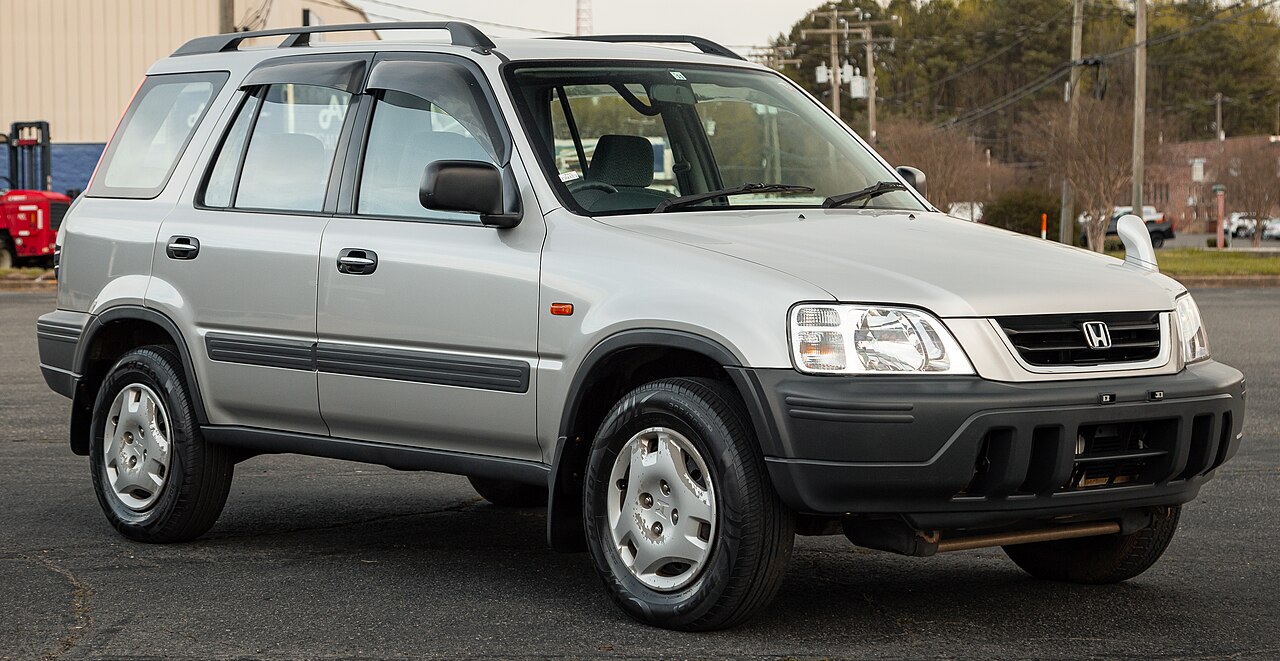
The first generation CR-V or RD1 was Honda's first in-house designed sport utility vehicle by Hiroyuki Kawase.
When the CR-V was introduced in Japan in October 1995 it was sold only at Honda Verno and Honda Primo dealerships and exceeded Japanese government's compact car regulations regarding exterior dimensions (maximum width of 1,700 mm (66.9 in), therefore incurred a more expensive annual road tax obligation.
For the North American market, it was displayed at the 1996 Chicago Auto Show and went on sale in February 1997.
Upon introduction, the model had only one trim level, which would later be known as the LX model trim; it was powered by the 2.0-litre straight-four B20B. Outer dimensions for this engine would be identical to the Integra's 1.8 L engine, but internally the engine had a larger 84 mm (3.3 in) bore vs 81 mm (3.2 in) for the Integra, to add the extra displacement needed to produce more torque. The engine used a one-piece cylinder sleeve construction unique from any other B-series engine. The chassis and suspension were largely similar to the 4th-generation Honda Civic Shuttle (Wagon) with a unibody design with fully independent suspension. The vehicle's suspension was double wishbone, while the rear used a trailing-arm-based multilink system. The rear seats were able to fold down and integrate with front seats that could fold flat, such that they formed a bed of sorts, about the size of a twin bed. Also, a picnic table was stowed in the rear floor area. All models featured plastic cladding covering the front bumper, rear bumper, and fender wells. In most countries, CR-Vs had a chrome grille; however, in the United States, the grille was made out of the same black plastic as the bumpers. The EX included anti-lock brakes and 15-inch alloy wheels over the LX trim. Drivetrain options were front-wheel drive or Honda's Real Time AWD.
The Indonesian market CR-V was released in 1999 as a locally assembled model. Honda customized the Indonesian model to include face-to-face third-row seating, making it a seven-seater vehicle to take advantage of the tax regulations in the country. The rear foglamp was also reconfigured as a fourth and fifth brake light.
Second generation (2002)
The second generation CR-V, which went on sale on 13 November 2001, was a full redesign, based on the seventh generation Civic, and powered by the K24A1 engine, or the K20A4 engine in Southeast Asia. Southeast Asian models produced 150 hp (112 kW) of power and 190 N⋅m (140 lbf⋅ft) while the North American versions of the new engine produced 160 hp (119 kW) and 219 N⋅m (162 lbf⋅ft) of torque. Per new SAE regulations, the same North American K24A1 engine is now rated at 156 hp (116 kW) and 160 lb⋅ft (217 N⋅m). The new CR-V retained the fuel economy of the previous model because of the i-VTEC system. The new chassis had increased torsional and bending rigidity, the suspension included a front toe control link MacPherson struts and a rear reactive-link double wishbone; the compact rear suspension increased cargo space to 72 cu ft (2,000 L). The second generation CR-V was Car and Driver magazine's Best Small SUV for 2002 and 2003.
Second generation CR-Vs in countries outside of North America were again offered in both "low specification" and "high specification" variants, with the latter featuring body-coloured bumpers and fittings. It also now did not require the glass hatch to be opened before the swinging door. Changes between model years 2002, 2003, and 2004 were minor, involving an enlargement of the centre compartment bin and the addition of a front passenger door power lock in the latter two years, respectively. The Honda FR-V was based on the second generation CR-V.
In China, a clone from Shuanghuan Auto, called the Laibao S-RV, became the centre of a design rights controversy, because the latter appeared to be a blatant copy of Honda's design.
Third generation (2007)
The third generation CR-V went on sale in the U.S. in late September 2006 for the 2007 model year. Portions of the body structure, drivetrain, and suspension were carried over from the previous model, while both interior and exterior styling elements were changed significantly. The CR-V now featured a rear liftgate and bottom-side spare tire mount rather than a side-opening rear door and door-mounted spare.
The third generation CR-V was powered by Honda's standard K-series 2.4 L inline-four engine. In North American markets, this engine's power is rated at 166 hp (124 kW) at 5,800 rpm and 161 lb⋅ft (218 N⋅m) at 4,200 rpm. A 2.2 L i-CTDI diesel engine was offered in the European and Asian markets. The European market CR-V had the R20A 2.0 L gasoline engine, based on the Honda R-series i-VTEC SOHC engine found in the Honda Civic, as opposed to the previous CR-V offering the K20A.
Fourth generation (2012)
The fourth generation CR-V concept debuted at the Orange County International Auto Show in September 2011, the production 2012 CR-V debuted at the 2011 Los Angeles Auto Show. The CR-V went on sale in the U.S. on 15 December 2011.
It was powered by a 2.4-litre i-VTEC inline-four engine that put out 185 hp and 163 pound-feet (220 Nm) of torque at 4,400 rpm along with an all-new Real-Time all-wheel-drive (AWD) with intelligent control system. All North American CR-Vs came equipped with a 5-speed automatic transmission.
Fifth generation (2017)
The fifth generation CR-V was unveiled on 13 October 2016 in Detroit. Sales began in the U.S. on 21 December 2016 as a 2017 model year. It used the same Honda compact global platform introduced on the tenth generation Civic. Honda began producing the CR-V at East Liberty, Ohio, (ELP) in November 2016 and at Greensburg, Indiana, (HMIN) during February 2017. It was available with an optional 7-seater variant in markets other than North America.
In October 2019, Guangqi Honda in China began marketing the model with a different styling as the Honda Breeze , which was sold alongside the international facelift version CR-V produced by Dongfeng Honda.
Sixth generation (2023)
The sixth-generation CR-V was unveiled on 12 July 2022 in Los Angeles, California, with sales commencing in the U.S. in September 2022 as a 2023 model year. It was based on the Honda Architecture platform that underpinned the eleventh-generation Civic. The CR-V was available with 5- and 7-seater configurations, which varied by market.
GAC Honda in China marketed the model as the Honda Breeze in December 2022, which featured different front and rear fascias. The plant that produces the sixth-generation CR-V for Dongfeng Honda was responsible for the export of CR-V models sold in Europe, which commenced in June 2023.
Living with it
Day to day, the CR-V's appeal is how little it asks of its driver: car-like seats and steering, a tall and flexible load space, and running costs closer to a family hatchback than to a traditional 4x4.
Model history and photograph may show different years or specifications. These are model-reference photographs, not vehicles offered for sale. No photographer or manufacturer endorsement is implied.
Sources and image credit
Structured record: Wikidata Q127433070 · checked 2026-11-06. The At a glance table is drawn from that record; fields the record does not contain are omitted.
Text adapted from the English Wikipedia article “Honda CR-V” (en.wikipedia.org), CC BY-SA 4.0 · checked 2026-11-06.