Car · Honda
Honda Fit: A Honda car
A Honda car. Some small cars apologise for being small; the Fit never did. By putting the fuel tank under the front seats, Honda freed a flat floor and fitted the Magic Seats, whose cushions flip up or fold flat so a bicycle, a pram or a tall plant can ride in a car barely four metres long. Since 2001, over four generations, that packaging trick has made the Fit — the Jazz in many markets — the small hatchback other makers measure themselves against.

2015-2017 Honda Fit Hybrid F Package.jpg · TTTNIS · CC0
Unmodified image file; scaled to fit the page. Photo remains under its stated license.
At a glance
| Maker | Honda |
|---|---|
| Type | Car |
First generation (GD/GE; 2001)
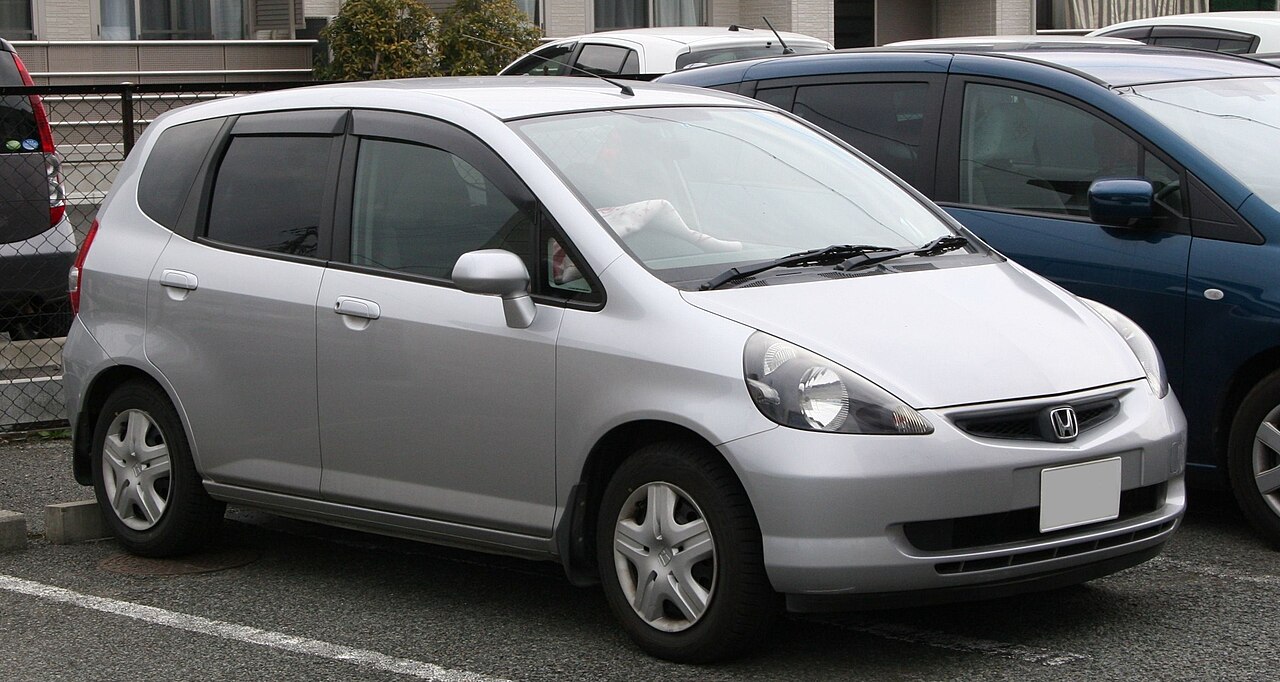
The first-generation Fit debuted in June 2001 in Japan and subsequently was introduced in Europe (early 2002), Australia (late 2002), South America (early 2003), South Africa and Southeast Asia (2003), China (September 2004), and Mexico (late 2005). Confusingly, in Europe this Jazz is typically referred to as Mark II Jazz, especially by automotive part suppliers, the Mark I Jazz being the 1981-86 Honda City, named 'Jazz' in Europe at the time, as Opel already had rights to use the City name after having used it on a hatchback version of the Kadett C.
A production model for the United States and Canada debuted in January 2006 at the North American International Auto Show in Detroit. The car was released in Canada and the U.S. in April 2006 as a 2007 model year.
The first-generation Fit uses Honda's Global Small Car platform, which is also used by Fit Aria/City (a sedan version of the Fit), the Airwave (a station wagon version of Fit Aria/City), the Mobilio, and Mobilio Spike. Depending on the region, the Fit is available with a 1.2-, 1.3- (in Europe referred as 1.4 L model), 1.5-litre i-DSI engine, or 1.5-litre VTEC engine. All four engines are based on Honda's L-series engine family.
Second generation (GE/GG; 2007)
The second-generation Fit/Jazz debuted on 17 October 2007 at the 40th Tokyo Motor Show. At its introduction in 2007, it won the Car of the Year Japan Award for the second time. The vehicle offered a longer wheelbase than its predecessor and is wider and longer overall.
Two engines were offered in the second-generation Fit. A Naturally Aspirated 1.2-litre i-VTEC DOHC produces 100 PS (99 hp; 74 kW) at 6,000 rpm and 127 N⋅m (13.0 kg⋅m; 93.7 lb⋅ft) at 4,800 rpm. A 1.5-litre i-VTEC engine was also offered and produces a maximum output of 120 PS (118 hp; 88 kW) at 6,600 rpm and 145 N⋅m (14.8 kg⋅m; 107 lb⋅ft) at 4,800 rpm. The hybrid version was launched October 2010 in Japan. The Fit Hybrid featured a 1.3-litre engine and electric motor, with an estimated fuel economy of 3.3 litres per 100 kilometres (86 mpg‑imp; 71 mpg‑US) measured in accordance with Japanese 10–15 cycle.
Honda also showed a concept electric vehicle based on the second generation Fit in 2010. It was mass-produced as the Fit EV in 2013–2015. The 2013 model year production Fit EV was unveiled at the November 2011 Los Angeles Auto Show.
For the first time, it was also available in a station wagon body style called the Fit Shuttle. This variant was only available in the Japanese home market.
Third generation (GK/GH/GP; 2013)
The third-generation Fit/Jazz retains the overall design concept of previous generations, notably the centre-located fuel tank and multi-configuration interior concept, marketed as "Magic Seat". The model also debuted Honda's updated design language dubbed "Exciting H Design".
Honda's all-new Global Small Car Platform employs ultra-high strength 780 MPa yield steel for 27 percent of the bodywork and has a shorter overall length by 4 cm (1.6 in), a 3 cm (1.2 in) longer wheelbase, increased rear legroom by 12.2 cm (4.8 in) and passenger volume increased by 136 L (4.8 cu ft) compared to the previous generation.
Body panels are both welded and bolted to the frame in a hybrid monocoque and spaceframe fusion — and rear torsion beam suspension is more compact, no longer using an anti-sway bar to maximize interior and boot space. The second-generation HR-V shares its platform with the third-generation Fit/Jazz.
Fourth generation (GR/GS; 2020)
The fourth-generation Fit/Jazz was unveiled simultaneously on 23 October 2019 in Japan at the 46th Tokyo Motor Show and Amsterdam, Netherlands at the 'Electric Vision' event.
This generation model has been developed with electrification in mind, with the model being marketed as a hybrid-only model in Europe, and the hybrid variant being positioned as a volume car in Japan. The hybrid powertrain is marketed as the 'e:HEV', which utilizes Honda's new dual-motor i-MMD (Intelligent Multi-Mode Drive) hybrid system, replacing the previous Intelligent Dual Clutch Drive (i-DCD) setup.
The fourth-generation Fit retains the large windshield, which offers optimal forward visibility. It also has a redesigned front pillar with a cross-section that is different from the previous generation. Honda stated that it improves impact absorption into the body in the event of a collision. Combined with the use of a flat dashboard and a visor-less instrument display, it provides the driver with a better view of their surroundings. The windscreen wipers have also been hidden below the top of the hood line. While the car was unveiled on October 23, 2019, it didn't start production until February 13, 2020. It went on sales a day later.
The model was discontinued in the North American market due to declining sales of the previous generation. HR-V production was expanded to compensate for the discontinuation of the Fit in North America. The model is also not being sold in Australia where it had been known as the Jazz. The cost was deemed too high for import, and the small car market has shrunk due to the popularity of small SUVs. In most countries in South America and Southeast Asia, the Fit/Jazz is replaced by the City Hatchback.
Powertrain
The fourth-generation Fit is offered with a new hybrid powertrain option marketed as the e:HEV, the system uses Honda's dual-motor i-MMD (Intelligent Multi-Mode Drive) hybrid system. The system combines a 1.5-litre DOHC i-VTEC four-cylinder petrol engine that on its own makes 98 PS (97 hp; 72 kW) from 5,600 to 6,400 rpm and 127 N⋅m (13.0 kg⋅m; 93.7 lb⋅ft) from 4,500 to 5,000 rpm with two electric motors, with one of them acting as a generator to recharge the lithium-ion battery while the other is an electric propulsion motor capable of spinning at 13,300 rpm to handle low-speed acceleration. The engine sends power to the front wheels through a single fixed-gear ratio and a lock-up clutch, which is claimed to provide a smoother transfer of torque during acceleration. The setup is claimed to be more compact and refined compared to a planetary eCVT typically found in other hybrid vehicles. The system is rated at 109 PS (108 hp; 80 kW) and 253 N⋅m (25.8 kg⋅m; 187 lb⋅ft) of torque.
The conventional petrol engine for the Japanese market is 1.3-litre naturally-aspirated i-VTEC four-cylinder, making 98 PS at 6,000 rpm and 118 Nm of torque at 5,000 rpm. It is mated to a CVT and a choice of either front or all-wheel drive.
Living with it
Living with a Fit is mostly about the seats: flip the rear cushion up for tall cargo, fold everything flat for a van-like floor, or leave it as a five-seat family hatch. It asks little in return — a light body, small engines and Honda's parts network keep running costs in supermini territory.
Model history and photograph may show different years or specifications. These are model-reference photographs, not vehicles offered for sale. No photographer or manufacturer endorsement is implied.
Sources and image credit
Structured record: Wikidata Q1135125 · checked 2026-11-06. The At a glance table is drawn from that record; fields the record does not contain are omitted.
Text adapted from the English Wikipedia article “Honda Fit” (en.wikipedia.org), CC BY-SA 4.0 · checked 2026-11-06.