Car · Honda · Introduced 2024
Honda N-Van: A Honda kei van
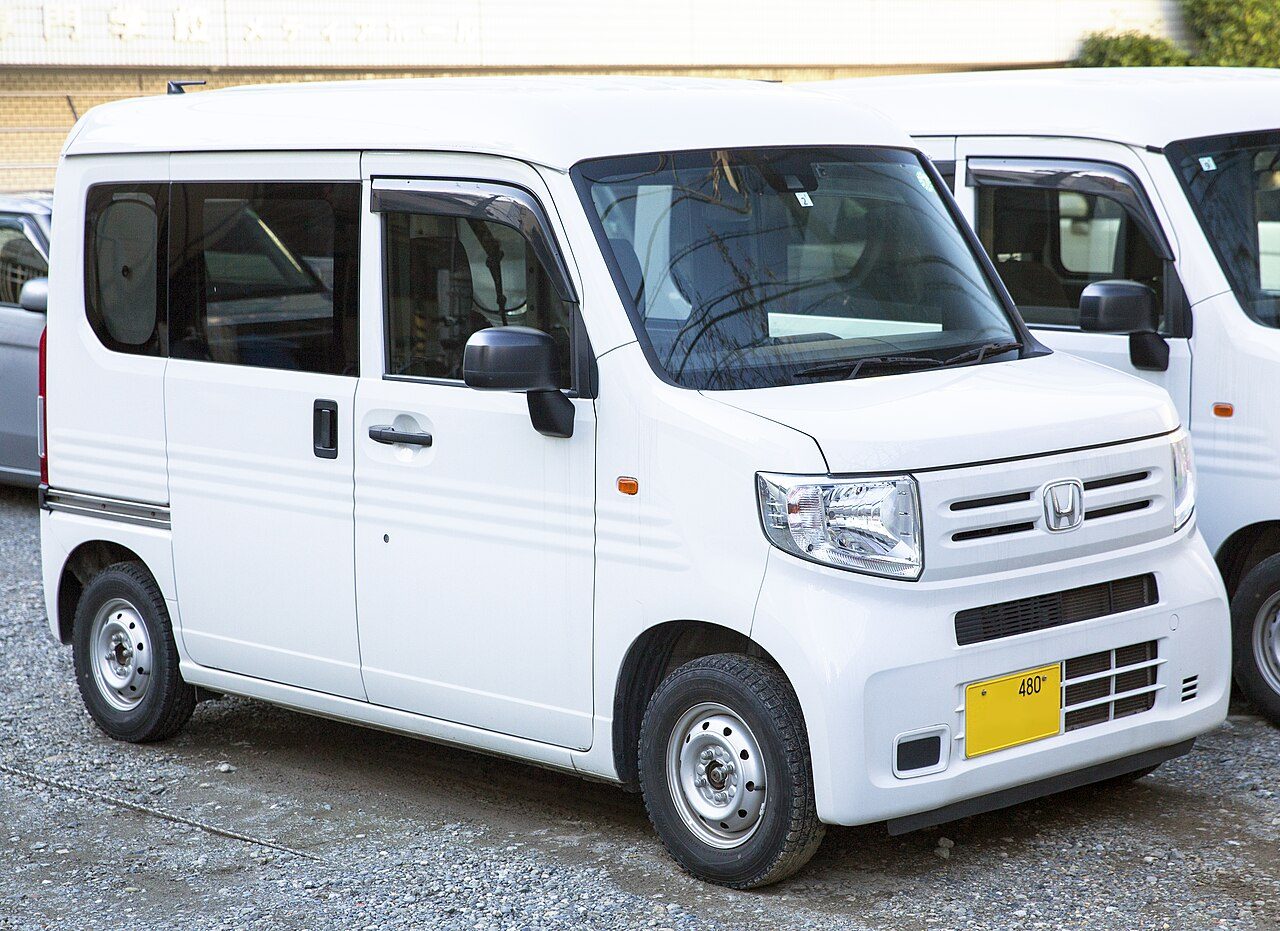
The N-VAN puts the N family's flat floor to work. It is a kei microvan aimed at tradespeople, delivery drivers and sole traders who need a van's flat, tall cargo box but a kei car's taxes, fuel bills and ability to fit down farm tracks and old shopping streets.

Honda N-VAN +STYLE FUN Honda SENSING (HBD-JJ1) front.jpg · Tokumeigakarinoaoshima · CC BY-SA 4.0
Unmodified image file; scaled to fit the page. Photo remains under its stated license.
At a glance
| Maker | Honda |
|---|---|
| Type | Car |
| Engine type | Gasoline engine |
| Length | 3,395 mm |
| Width | 1,475 mm |
| Height | 1,950 mm |
Overview
It was developed with the aim of "a new appearance" of light commercial vehicles in the fifth series of "N series" deployed starting with the first N-BOX released in November 2011. In addition to being the first commercial vehicle in the series, it is also a substantial successor to Acty van, Vamos, & Vamos Hobio which were previously sold.
From the semi-cab overstyle Acty line, it adopts a tall wagon style based on the FF car platform developed at the second generation N-BOX. As a result, the length of the luggage compartment has been greatly reduced by comparison with Acty which had adopted the mid-ship engine layout (the luggage compartment length is 1,510 mm (59 in) on the left side and 1,330 mm (52 in) on the right side, shortening by 215–395 mm (8.5–15.6 in) respectively).
On the other hand, for the first time as a microvan, we adopted a "door-in-pillar structure" that eliminated the centre pillar on the side of the passenger's side to improve usability in loading and unloading operations of long objects, etc. In addition, similar to the N-Box centre tank layout by adopting a low floor by adoption, the cargo compartment height was expanded to 1,365 mm (53.7 in) which was 165 mm (6.5 in) higher than Acty van. In addition to the rear seat, a dive down mechanism is also adopted for passenger's seat, realizing a luggage room connected from the front passenger's seat to the rear seat/tailgate. It is also possible to load long objects. The minimum ground clearance is approximately 15 to 15.5 cm (5.9 to 6.1 in).
Variants
There were initially four trim variations available for the Honda N-Van, the L, G, +Style Cool and +Style Fun. The +Style Cool model omits the raised roof, for a 1,850 mm (73 in) height instead of the 1,950 mm (77 in) height on the other models. The +Style Cool was discontinued in February 2021. All models are available with a choice of FWD or AWD drivetrain and a choice of CVT transmission or a 6-speed manual transmission.
The engine variants come from Honda's S-series and are available in naturally-aspirated and turbocharged versions. In the naturally-aspirated version it makes 39 kW (53 PS) and 64 Nm of torque, and is offered on all models. The DOHC turbocharged engine is only available on the +Style Cool Turbo and +Style Fun Turbo trims; it makes peak 47 kW (64 PS) and 104 Nm. The engine is an improved version based on the S660.
All trims come with a full digital auto air conditioner as standard equipment.
N-Van e: (2024)
The battery electric variant of the N-Van, named "N-Van e:", went on sale in Japan in the second quarter of 2024. The N-Van e: is available in four different models: the e:L4 and the e:FUN (a leisure-oriented variant with round LED headlights) target private buyers and are available for direct purchase, while the business-only single-seater e:G and the e:L2 (two seats in tandem) are only available for leasing. The business models have a less powerful engine than the e:L4 and e:FUN, producing 39 kW (53 PS) rather than 47 kW (64 PS).
The weights range between 1,060 and 1,140 kg (2,337 and 2,513 lb). The additional weight and lower centre of gravity – since the batteries are mounted beneath the floor – coupled with larger, 13-inch wheels, give the car more sure-footed driving characteristics than the internal combustion engine (ICE) variants. The more powerful engine also has fifty percent more torque than the turbo version, which counteracts the added weight and generally makes the car better suited to highway use.
Fuel economy
For the +STYLE FUN Turbo model, the Fuel consumption rate based on the Japan Ministry of Land, Infrastructure, Transport and Tourism's examination value in WLTC mode is 18.8km/L and 23.6km/L on the JC08 mode. For fuel economy, there is an idle stop function that stops the engine when the vehicle is stopped such as waiting at a traffic light to reduce fuel consumption and emissions. There is an ECON switch to turn on the ECON mode, where the entire vehicle is automatically controlled in a low fuel consumption mode, not only the engine but also the air conditioner. This prioritises fuel efficiency.
Luggage and storage
The engine is in the front of the car, and the fuel tank is under the front seat. The height difference from the ground to the luggage/storage floorboard is 525 mm (21 in), making it easier to load items into the van. By adopting the same FF platform as the N-BOX, the N-VAN shortens the length of the engine compartment and makes it more compact, allowing more space for cargo and passengers. The maximum load capacity is 350 kg (772 lb).
The N-Van comes with a full range of user-focused equipment and storage, such as a stopper to prevent objects from falling under the driver's seat, trays and hooks on the instrument panel and inside the front door, and a USB jack that is convenient for charging smartphones and tablets.
Long or large and heavy items can easily be loaded and unloaded smoothly from the passenger side, and speedy work is possible with access from multiple openings. Loading and unloading from the sidewalk is safe when the tailgate cannot be opened or in areas with heavy traffic, as the passenger side has a door-in pillar structure, thus the b-pillar is pillar-less, and the first time seen in a light goods can.
You are able to freely arrange the space in the rear by attaching pipes and shelves as there are a total of 28 utility nuts on the left and right walls of the storage compartment and in the inside of the tailgate. Once the cap is removed, it can be used as an M6 size screw hole, to attach pipes, shelves and metal fittings.
There are eight tie down hooks to secure your cargo with belts and springs, with two hooks at the foot of the passenger seat and two at the back, with the remain four hooks on the luggage compartment floor for furniture, bicycles, and even motorbikes.
Living with it
The working details are the point: a low flat floor that takes cargo lengthways, and a passenger seat that folds into the load space. From 2024 an electric version joined the range for fixed-route delivery work.
Model history and photograph may show different years or specifications. These are model-reference photographs, not vehicles offered for sale. No photographer or manufacturer endorsement is implied.
Sources and image credit
Structured record: Wikidata Q60760189 · checked 2026-11-03. The At a glance table is drawn from that record; fields the record does not contain are omitted.
Text adapted from the English Wikipedia article “Honda N-Van” (en.wikipedia.org), CC BY-SA 4.0 · checked 2026-11-03.