Car · Toyota
Toyota AE86: The light coupé that taught drifting
The light coupé that taught drifting. The AE86 series of the Toyota Corolla Levin/Sprinter Trueno are small, front-engine/rear-wheel-drive compact cars within the mostly front-engine/front-wheel-drive fifth generation Corolla (E80) range—marketed and manufactured by Toyota from 1983 to 1987 in coupé and liftback configurations.
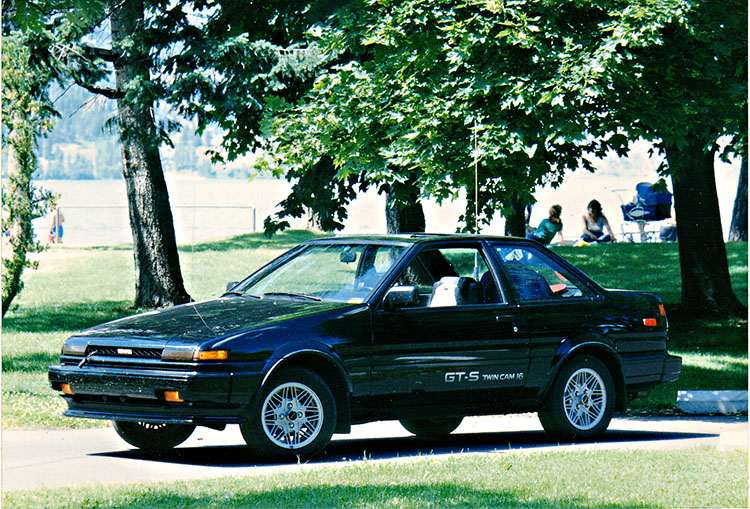
New stock ae86 coupe.jpg · Jeff lange at English Wikipedia · Public domain
Unmodified image file; scaled to fit the page. Photo remains under its stated license.
At a glance
| Maker | Toyota |
|---|---|
| Type | Car |
H2 and BEV concepts
In January 2023 at the Tokyo Auto Salon, Toyota Gazoo Racing (TGR) and Lexus exhibited two AE86 liftbacks concept cars called H2 and BEV Concepts that have been converted to run using a hydrogen engine and a battery-electric system. The H2 concept was based on the Sprinter Trueno and converted by TGR to run on hydrogen fuel while retaining the original 1.6 L engine that received special modifications, including fuel injectors, fuel pipes, and spark plugs and combined with two high-pressure hydrogen storage tanks from the Mirai. The BEV concept was based on the Corolla Levin that was converted as a battery electric vehicle by Lexus by combining an electric motor from the Tundra Hybrid, an 18.1-kWh battery from Prius PHEV/Lexus RX450h+ and also featured a manual transmission.
Motorsports
During its production run, the AE86 was a popular choice for showroom stock, Group A, and Group N racing, especially in rallying and circuit races. It competed in the under 2.0 L class, mostly in 1401 to 1600 cc A6 or N2 classes. After the production ended, many privateer teams continued to race the AE86, and it remains a popular choice for rallying and club races today.
Part of the continued appeal of the AE86 for motorsports is its rear-drive configuration, not available in most newer lightweight coupes. In Group A touring car races, the car either dominated the lower category where eligible or fought it out with Honda Civics or the later AE92s and AE101s whilst maintaining its competitiveness. In Ireland, where rallying is considered one of the most popular forms of motorsport, as organizing regulations are more relaxed compared to that of other countries, the AE86 was popular when new, and remains so popular that teams will purchase cars from the UK and Japan due to local shortages. The AE86 is also popular for rally use in Finland, where the cars can be competitive in the F-Cup competition for naturally aspirated 2WD cars.
From 1984 until late 1990s, many privateer teams competed with AE86s in World Rally Championship (WRC) events. Some of them found success by winning their class and sometimes became eligible to score WRC championship points when they finished in the top ten of the overall classifications. The first respectable result was in the 1984 Rally de Portugal, when driver Jorge Ortigão and co-driver João Baptista finished in second place behind the Group A class winner, the Volkswagen Golf GTi (Mk1), and finished in eighth place overall among the more powerful Group B cars. The first class win came three rounds later in the Acropolis Rally, when Manolis Halivelakis and Konstantinos Exarchos finished thirteenth overall. The best result of AE86 in WRC was in the 1989 Rallye Côte d'Ivoire when Adolphe Choteau and Jean-Pierre Claverie finished third overall.
The AE86 competed in the Division 1 European Touring Car Championship (ETCC) from 1984 to 1988, where its main rivals were the Volkswagen Golf GTi (Mk2) and Audi 80 GLE. In 1986 it beat the Division 2 BMW 325i (E30) and Division 3 BMW 635i CSi to win the Manufacturers Championship with 267 points.
In 1986 and 1987, Chris Hodgetts won the British Touring Car Championship (BTCC), beating the V8 Rover SD1's, Ford Sierra Cosworth's and BMW 3 Series (E30) M3's two years running for an overall points victory driving an AE86 for Toyota (GB) PLC and his own race prep team CHMS.
Five different teams won eight of eleven races in Division 1 class in the 1987 World Touring Car Championship (WTCC). However, none of these teams were eligible to score championship points. The Corolla GT also successfully dominated its class in European endurance races like the Spa 24 Hours and Nürburgring 24 Hours throughout the 1980s.
From 1985 to 1988, the Corolla Levin participated in Division 1 of the All Japan Touring Car Championship (JTC). Kaoru Hoshino, from the Trampio Levin team, won the 1985 Division 1 class championship and placed third overall with two wins and two second-place finishes. In the following seasons, the AE86 faced a fierce battle from the Civic Si and was also overshadowed by the more competitive front-wheel drive AE82 Corolla FX-GT. The semi-factory supported Kraft team entered a spaceframe Trueno in the JGTC for the GT300 regulations in 1999. The Trueno used a Dallara F3 chassis and was powered with a 3S-GTE engine that came from a SW20 MR2 Turbo that produces about 300 hp (224 kW). Despite being popular with the fans, the car had minor success and was abandoned from use halfway through the 2001 season when the AE86 burst into flames during the third round of the season at Sugo. Kraft subsequently replaced it with the newly-delivered Toyota MR-S.
The Toyota Team Australia (TAA)-prepared AE86s dominated the under 2.0 L class in the Australian Touring Car Championship, the Australian Endurance Championship, and the Australian 2.0 Litre Touring Car Championship from 1985 to 1986. TTA secured five class titles across those championships: four by John Smith and one by Mike Quinn in the 1986 Australian Endurance Championship. The AE86 was also highly successful at the Bathurst 1000, although its victories were mostly against other AE86s and the front-wheel drive AE82. The TTA AE86s secured class victories in 1985, 1986 and 1988. Following their success, privateer teams running the local market Sprinter liftback model also achieved victories: Bob Holden Motors won in 1987, Phoenix Motorsport in 1990, and Speedtech Motorsport in 1991.
Model history and photograph may show different years or specifications. These are model-reference photographs, not vehicles offered for sale. No photographer or manufacturer endorsement is implied.
Sources and image credit
Structured record: Wikidata Q1377219 · checked 2026-11-03. The At a glance table is drawn from that record; fields the record does not contain are omitted.
Text adapted from the English Wikipedia article “Toyota AE86” (en.wikipedia.org), CC BY-SA 4.0 · checked 2026-11-03.